Tag Archives: Colombia

Trump Pardons a Convicted Drug Dealer While Starting a War Against Venezuela to Fight “Drug Dealers”

bread on white plastic pack

By Timothy Alexander Guzman at Global Research. Reposted with permission.

f someone or some organization can win an award for hypocrisy, the Trump regime would win in a landslide. Recently, US President Donald Trump has pardoned Juan Orlando Hernandez, a former president of Honduras and a convicted drug trafficker known as the‘Narco-Dictator’ who was convicted by a grand jury in New York City for importing 400 tons of cocaine and weapons into the United States. According to the Department of Justice (DOJ), Mr. Hernandez was convicted “for cocaine importation and related weapons offenses.” Let that sink in for a minute, Hernandez helped import more than ‘400 tons’ of cocaine and weapons into the United States, and Trump pardoned him, at the same time, a new war is on the table in Washington to remove Venezuela’s President Nicolas Maduro for allegedly sending drugs into the United States. This is hypocrisy on steroids.

The Department of Justice published a Press Release on June 6, 2024, titled, Juan Orlando Hernández, Former President of Honduras, sentenced to 45 Years in Prison for Conspiring to Distribute More Than 400 Tons of Cocaine and Related Firearms Offenses.’ The following statement explains in a nutshell what Hernandez was clearly involved in: 

As President of Honduras, Juan Orlando Hernández abused his power to support one of the largest and most violent drug trafficking conspiracies in the world, and the people of Honduras and the United States bore the consequences,” said Attorney General Merrick B. Garland. “Thanks to the diligent work of the Justice Department’s agents and prosecutors, Hernández will now spend more than four decades in prison. The Justice Department will hold accountable all those who engage in violent drug trafficking, regardless of how powerful they are or what position they hold

Image: Juan Orlando Hernández (CC BY-SA 2.0)

The evidence against Hernandez was undeniable:  

Hernández looking to the side in a suit

As the former two-term president of Honduras, Juan Orlando Hernández had every opportunity to affect positive change for his country,” said U.S. Attorney Damian Williams for the Southern District of New York. “Instead, Hernández helped to facilitate the importation of an almost unfathomable 400 tons of cocaine to this country: billions of individual doses sent to the United States with the protection and support of the former president of Honduras. Now, after years of destructive narco-trafficking of the highest imaginable magnitude, Hernández will spend 45 years where he belongs: in federal prison

However, Trump is fighting “Narco-terrorists” from Venezuela because he is concerned about the American people, right?  When Trump first announced on September 2nd, that the US Navy hit an alleged drug boat in the Caribbean, he said that a “kinetic strike against positively identified Tren de Aragua Narco-terrorists in the SOUTHCOM area of responsibility” and that the attack took place while the boat was “at sea in International waters transporting illegal narcotics, heading to the United States.” Trump boasted that “the strike resulted in 11 terrorists killed in action” he continued, “TDA is a designated Foreign Terrorist Organization, operating under the control of [Venezuelan President] Nicolas Maduro, responsible for mass murder, drug trafficking, sex trafficking, and acts of violence and terror across the United States and Western Hemisphere.”

Fox News, one of the mainstream media outlets who is cheerleading for a war on Venezuela reported that Trump is prepared to order direct attacks, “on land” inside Venezuela, warning that the Nicolás Maduro regime has already sent “killers, murderers … gang members” and other violent offenders into the U.S. during past years of mass migration” Trump continued, “We’re knocking out drug boats right now at a level that we haven’t seen,” and that “Very soon we’re going to start doing it on land too.”

Trump claimed that “We know every route. We know every house. We know where they manufacture this crap, the poison … they’ve been feeding us.” This made me think that if the US military started bombing Venezuela, and they hit a civilian target and murder innocent people, will Trump conveniently claim that drug dealers were hiding there? That will be the same excuse Israel uses when they hit civilian targets in Gaza claiming that Hamas was hiding among civilians and using them as human shields.

As Trump’s team of zionists and neocons prepare for a possible war against Venezuela, he pardons Hernandez, a big time drug dealer who helped ship 400 tons of cocaine and weapons into the US. Maybe Hernandez will be used for another ‘Iran-Contra Scandal’ for a secret operation involving drugs against another Latin American nation who is on Washington’s hit list that can include Cuba, Nicaragua and possibly Colombia to re-establish full-spectrum dominance in their “backyard,” with this regime, anything is possible.    

Can a War on Venezuela Become Another Vietnam in Latin America?

The problem with a US war on Venezuela is that it won’t be a cakewalk. Just imagine this, the US tapped out in a short battle against the Houthis of Yemen in the Red Sea, yet, they want to challenge Venezuela, a country that is twice the size of Yemen with a civilian militia of more than 4 million people alongside 300,000 plus well-trained soldiers willing to fight for their country. Venezuela’s military is armed with mostly Russian and Chinese made weapons that includes Surface-to-Air Missile systems such as the S-300 VM Antey, the Buk M2 and the Buk M2E that can give US fighter jets and bombers a run for their money. Venezuela’s military can also fight a US invasion by using guerrilla warfare tactics within their cities, vast jungles and mountains. Neighboring countries such as Colombia and Brazil will surely have people that will volunteer alongside Venezuelans to fight against the ‘Gringo Invasion.’  

So how will the US Navy and the Marines do in an all-out war against Venezuela given the fact that Venezuela has a standing army and a civilian militia who will be ready to fight the US empire to the very end? The US public will end up witnessing US Navy sailors and Marines coming home in body bags on the evening news. 

I mention Yemen because it was the most recent conflict under Operation Rough Rider, a failed operation against the Houthis of Yemen that involved the US Navy who eventually had to retreat from the short-lived battle at the Red Sea.     

The Middle East Monitor‘A Story of Retreat: America’s Failure in the Red Sea’ mentions that after two months of fighting, Trump had established a ceasefire with the Houthi resistance, why? The US Navy could not withstand Yemen’s persistent missile attacks and their relentless determination to fight the US and Israel in the Red Sea:

In spring 2025, the Red Sea became a tense battleground between the United States and Yemen’s Houthis—a part of the so-called Resistance Axis who had intensified their attacks on international shipping. U.S. President Donald Trump, vowing to restore deterrence and secure freedom of navigation, launched a large-scale military operation titled Operation Rough Rider against the Houthis. This campaign—costing over $1 billion and involving aircraft carrier strike groups, B-2 bombers, and advanced missiles—was intended to cripple the Houthis’ military capabilities. However, just two months after the operation began, on May 6, 2025, Trump unexpectedly announced a ceasefire agreement with the Houthis—a deal effectively brokered by bypassing Israel, and one that ultimately brought the U.S.-Yemen conflict to a halt  

The consequences of the Trump regime’s actions against the Houthis are undeniable:

Trump’s failed war and the ceasefire agreement had deep consequences for both U.S. credibility and Houthi positioning in Yemen. For America, the failure weakened its regional and global standing. The Houthis emerged stronger after surviving over 1,000 airstrikes, casting doubt on U.S. military efficacy. The heavy use of precision-guided munitions—vital for potential conflicts with China—raised concerns within U.S. Indo-Pacific Command

Trump’s ceasefire meant a Houthi victory against the US Navy: 

For the Houthis, the ceasefire bolstered their standing in Yemen and across the region. They framed the agreement as a victory, solidifying their control over large parts of the country. Continued attacks on Israel despite the U.S. ceasefire illustrated their regional ambitions and unwavering resolve to play a major role in reshaping Middle Eastern and even global dynamics

The US Navy and over 17,000 Marines are now awaiting orders in the Caribbean Sea to enter Venezuelan territory for a regime change operation, but it’s going to be another quagmire. 

This war is about oil and other valuable resources, but it is also about making sure that the BRICS alliance does not influence Latin America to eventual ditch the US dollar. The US government with Trump and his Secretary of State, Marco Rubio are leading the charge and are hoping that they can get their dirty hands-on Venezuela and impose one of their puppets to become Venezuela’s next president such as the “Nobel Prize Winner” Maria Corina Conchado. Conchado has openly called for the Trump regime to bomb her own country so that US corporations can once again, control the oil and other natural resources. 

Trump’s approval rating would sink further into the abyss, probably into the single digits if he goes to war against Venezuela. Expect Anti-War protests all over the world as the US government would be seen once again, as the belligerent actor on the world stage.

Let’s hope that the Trump regime will back off Venezuela, but with an economy that is slowly collapsing due to his reckless tariffs, mass layoffs in government and private industries, the Epstein files scandal, and other failures including rising tensions in the Middle East with the Gaza genocide still going on, unfortunately, a new war seems more likely by the day to distract the US population from Trump’s economic and foreign policies disasters. Let’s hope some sort of diplomacy can prevail, but I must admit, when it comes to Washington’s thirst for war, I am very pessimistic.   

*

Click the share button below to email/forward this article. Follow us on Instagram and X and subscribe to our Telegram Channel. Feel free to repost Global Research articles with proper attribution.

Timothy Alexander Guzman writes on his own blog site, Silent Crow News, where this article was originally published. He is a regular contributor to Global Research.

Featured image is from the author

You can support this ministry and keep us on the internet using the links below.  Patreon is gone so now we have PayPal, Cash App and Buy me a Coffee as our online options.  The buy me a coffee link is below.

Free Ebook on Spiritual Warfare

Buy me a Coffee

Cash App ID: $jstorm212

Trump Administration Justifies Murder and War Crimes in the Caribbean

white and black i love you print on white wooden table

What the Trump admin. is doing in the Caribbean is murder and a war crime. They can lie and try to justify it all that they want but it doesn’t hold up under scrutiny. If their goal was to stop the drug trafficking then why is Trump pardoning them?

White House Confirms Hegseth gave the order

Trump to Pardon Ex Honduras President convicted of drug trafficking

This is murder article

You can support this ministry and keep us on the internet using the links below.  Patreon is gone so now we have PayPal, Cash App and Buy me a Coffee as our online options.  The buy me a coffee link is below.

Free Ebook on Spiritual Warfare

Buy me a Coffee

Cash App ID: $jstorm212

A Duty to Disobey Unlawful Orders

In surprise move, head of US military for Latin America to step down, was the headline a month ago when Adm. Alvin Holsey, the commander of U.S. Southern Command (SOUTHCOM), announced his unexpected retirement less than a year after assuming the role. Guess why he stepped down?

As the Democrats and Trump fight over this issue the service members could become divided as well. It has also dominated the news cycle taking over for the Epstein files as the latest distraction.

The many ways the military crossed the line

Duty to Disobey Trailer

You can support this ministry and keep us on the internet using the links below.  Patreon is gone so now we have PayPal, Cash App and Buy me a Coffee as our online options.  The buy me a coffee link is below.

Free Ebook on Spiritual Warfare

Buy me a Coffee

Cash App ID: $jstorm212

US Secretary of State Marco Rubio’s Colombian “Narcoterrorist” Hypocrisy.

By Kurt Nimmo at Global Research. Reposted with permission.

President Gustavo Petro Dismissed as A Lunatic which is actually a more accurate description of Rubio and others in the Trump administration. Johnny

On October 22, President Trump’s Secretary of State, Marco Rubio, dismissed Colombian President Gustavo Petro as a “lunatic.” Rubio mad the remark after Petro denounced the US for murdering fishermen erroneously described as “narcoterrorists” on an improbable run in the Caribbean to deliver illegal drugs to the United States. 

“I think the Colombian authorities, when it comes to, like, the military and the police, are still very pro-American. The only problem in Colombia is a lunatic president,” Rubio said. “The guy’s a lunatic—a lunatic!—and he’s not well,” the Secretary of State added. 

The Trump administration insists Petro has failed to adequately combat drug trafficking. On October 19, on his “Truth” social, Trump took the accusation a step further. He said

Petro “is an illegal drug leader strongly encouraging the massive production of drugs, in big and small fields, all over Colombia.” 

Here is a truth social post Trump put up on Oct. 19th 2025.

President Gustavo Petro, of Colombia, is an illegal drug leader strongly encouraging the massive production of drugs, in big and small fields, all over Colombia. It has become the biggest business in Colombia, by far, and Petro does nothing to stop it, despite large scale payments and subsidies from the USA that are nothing more than a long term rip off of America. AS OF TODAY, THESE PAYMENTS, OR ANY OTHER FORM OF PAYMENT, OR SUBSIDIES, WILL NO LONGER BE MADE TO COLOMBIA. The purpose of this drug production is the sale of massive amounts of product into the United States, causing death, destruction, and havoc. Petro, a low rated and very unpopular leader, with a fresh mouth toward America, better close up these killing fields immediately, or the United States will close them up for him, and it won’t be done nicely. Thank you for your attention to this matter! President Donald J. Trump

The purpose of this drug production is the sale of massive amounts of product into the United States, causing death, destruction, and havoc. Petro, a low rated and very unpopular leader, with a fresh mouth toward America, better close up these killing fields immediately, or the United States will close them up for him, and it won’t be done nicely.

Rubio’s remarks on Colombian “narcoterrorism” should be put in context. Omitted from the accusation that Petro traffics drugs is an allegation that the former president of Colombia was linked to the Medellín Cartel and death squads. 

Rubio’s Close Relationship with Álvaro Uribe

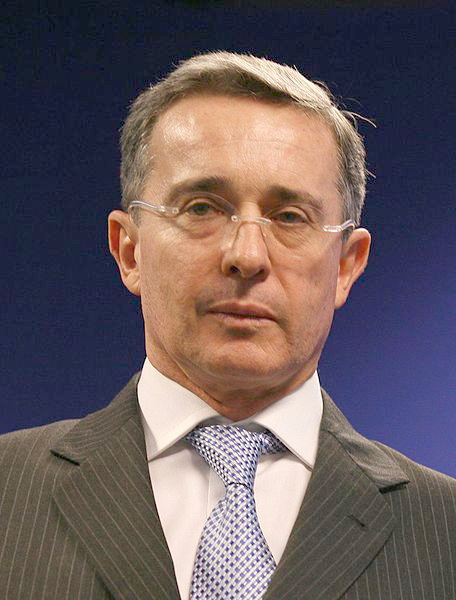
Image: Álvaro Uribe (CC BY-SA 2.0)

undefined

The former president of Colombia, Álvaro Uribe, had two convictions for fraud and bribery overturned on October 21. The rightwing politician, backed by Trump during his first administration, was convicted of bribing imprisoned paramilitaries to discredit claims he was linked to their organizations. 

“Colombia’s judicial system found former President Álvaro Uribe Vélez guilty of witness tampering, specifically for abuse of process and bribing a public official,” according to Gimena Sánchez-Garzoli, writing for the Washington Office on Latin America.

Uribe collaborated with paramilitary death squads during Colombia’s war against FARC (Fuerzas Armadas Revolucionarios de Colombia), a revolutionary group formed in 1964 by the Colombian Communist Party to defend what were then autonomous Communist-controlled rural areas. He faced numerous allegations of human rights abuses during his stint in office from 2002 to 2010. Uribe turned a blind eye to extrajudicial killings and massacres by death squads, according to human rights organizations

During the first Trump administration, then senators Marco Rubio and Bob Menendez (later convicted on corruption charges), both serving as members on the Senate Foreign Relations Committee, shared a “close relationship” with Uribe. Rubio stated that he is “a big fan of President Uribe,” while “multiple sources confirm that Rubio and Uribe are in constant communication, while others confirm that Uribe is a frequent fixture in the U.S. Congress.”

This support was evident last year when Uribe held a conference in Miami. During the event, Rubio, accompanied by Representatives Mario Diaz-Balart and Carlos Curbelo, applauded Uribe as, “a leader who stands up for democracy in Colombia and the threat of a possible leftist tyranny backed by Cuba and Venezuela.”

Rubio believes “the United States should continue to support Colombia’s efforts to combat terrorism and narcotics,” despite an allegation that the former Colombian president was a cartel operative. 

Uribe’s Link to Pablo Escobar and the Medellín Cartel

In 1991, a US Defense Intelligence Agency (DIA) report was released under a Freedom of Information Act request filed by the National Security Archives (NSA). The report “placed Uribe, then a senator, among Colombia’s top narcotrafficking figures,” and said he was “dedicated to collaboration with the Medellin Cartel at high government levels” and was “a close personal friend of Pablo Escobar,” according to the NSA

diplomatic cable listed Uribe as a Colombian “Narcopols,” and further stated that “an Uribe ally told the Embassy that the notorious Ochoa Vásquez brothers, co-founders of the Medellín Cartel, had ‘financed’ Uribe’s Senate campaign.” Moreover, according to the NSA, documents “reinforce the idea that Uribe’s links to the illegal militias have always been something of an open secret, part of a wider acceptance of paramilitaries among certain Colombian elites.”

“Washington portrays Uribe as a key ally in the war on drugs and terrorism, boasting that his administration has extradited 150 accused traffickers to the US, more than twice the number extradited in his predecessor’s four-year term,” notes the NSA’s David Bloom, citing an article in The New York Times. “But there have been persistent claims that as chief of Colombia’s civil aviation authority in the late 1980s, Uribe protected drug flights. When he was governor of Antioquia between 1995 and 1997, paramilitary activity exploded in the department.”

Targeting Leftist Governments, Not Drugs

Image: President Gustavo Petro Urrego of Colombia addresses the UN General Assembly in 2023 (Photo credit: UN)

The problem for the US with Gustavo Petro is not drugs. It is the fact he is a leftist with an ambitious agenda. In late 2022, with the help of centrist and right-wing parties (the “Historic Pact”), he passed a progressive tax reform. The law increased taxes on Colombia’s top earners and established higher royalties on the extraordinary profits in the extractive industries.

“For the first time in many decades we are talking about taxing the upper echelons of the population in order to finance spending and investments for the poorest people of this country,” Petro said.

In addition, Petro’s government initiated “Total Peace,” a plan to negotiate with all the armed forces operating in Colombia in an effort to end decades-long armed conflict that has killed hundreds of the thousands of Colombians. 

César Bowley Castillo, a scholar of Colombian social movements, notes a number of foreign policy achievements attributed to the Petro government.

“Petro’s been a leader on Palestine, and this has created space for other Latin American leaders to take similar stances. Petro has now stopped shipping Colombian coal to Israel. And he’s been a leader on climate. He’s also reestablished relations with Cuba and Venezuela, something no previous president would have done,” Castillo said. 

In regard to Venezuela, Petro has worked with Nicolás Maduro on issues of mutual concern, an effort that no doubt alarms the Trump administration. The Colombian president declared “that Colombia and Venezuela are the same people, the same flag, and the same history.” Petro made the remarks “in defense of Venezuela and in response to the threats from the United States,” Natalia Falah wrote for Colombia One in August. 

In September, Petro went before the U.N. General Assembly and called for a criminal investigation against President Donald Trump and other officials involved in deadly strikes on fishing boats in the Caribbean that the White House insists were transporting drugs. 

“Criminal proceedings must be opened against those officials, who are from the U.S., even if it includes the highest-ranking official who gave the order: President Trump,” Petro said. He said the boat passengers were not members of the Tren de Aragua gang, as claimed by the Trump administration. “They said that the missiles in the Caribbean were used to stop drug trafficking. That is a lie stated here in this very rostrum,” Petro said.

On October 22, Trump expanded his attacks to the Pacific Ocean, where he targeted a vessel off the coast of Colombia, killing two people. It was the ninth attack on vessels the Trump administration insists are operated by “narcoterrorists” attempting to smuggle drugs into the United States. 

Manifest Destiny Reprise

The United States has a long history of attacking and undermining governments in Latin America, beginning as early as 1846 with the doctrine of Manifest Destiny and the war against Mexico. In the 1850s, the US intervened in Nicaragua and Panama, the latter at the behest of the Atlantic-Pacific railroad. 1898 brought war with Spain and the US occupation of Cuba, Puerto Rico, Guam, and the Philippines. In the early 20th century, the US passed the Platt Amendment, giving it a freehand to intervene across the Latin America. Cuba, Panama, the Dominican Republic, Colombia, Mexico, Honduras, and Haiti endured US interventions. 

“I helped make Mexico, especially Tampico, safe for American oil interests in 1914,” wrote US Marine Major General Smedley Butler. “I helped make Haiti and Cuba a decent place for the National City Bank boys to collect revenues in. I helped in the raping of half a dozen Central American republics for the benefits of Wall Street. The record of racketeering is long. I helped purify Nicaragua for the international banking house of Brown Brothers in 1909-1912. I brought light to the Dominican Republic for American sugar interests in 1916.”

The “record of racketeering” continues today as Donald Trump attempts to force an updated version of the Monroe Doctrine on Latin America. “It has been the formal policy of our country since President Monroe that we reject the interference of foreign nations in this hemisphere and in our own affairs,” Trump declared during a September 2018 speech before the United Nations. 

The current “interference” stems from the involvement of China and Russia in Mexico, Columbia, Cuba, Nicaragua, Venezuela, Bolivia, Peru, and Ecuador. In addition to foreign trade, in both consumer goods and military hardware, the US has, since the Cold War, attempted to undermine socialist governments in Latin America. The US claimed to be fighting the spread of communism. Its coups and establishment of authoritarian regimes has resulted in widespread death, suffering, and poverty. 

Over the last thirty odd years, the has US shifted the focus in Latin America from defeating communism, and later terrorism, to the war on drugs. It can be argued Trump is less interested in combatting the drug cartels than maintaining the “Washington Consensus” of “trade liberalization” enforced by the International Monetary Fund, the World Bank, and the US Treasury. 

“Across Latin America, governments are watching with growing unease as a new kind of Monroe Doctrine seems to be taking shape,” writes Pierre Haski. “Trump seems to draw inspiration from that imperial era.” 

Again, the underlying motivation, obfuscated by a claim to be fighting against drugs and narcoterrorists, is to make sure Latin America is dominated by Wall Street interests, and unfriendly leaders such as Maduro and Petro are driven from power and corporations enjoy the freedom to extract oil and critical minerals like lithium and copper without the resistance of nearly 700 million people, more than 170 million of them living in extreme poverty. 

*

Click the share button below to email/forward this article. Follow us on Instagram and X and subscribe to our Telegram Channel. Feel free to repost Global Research articles with proper attribution.

Kurt Nimmo is a journalist, author, and geopolitical analyst, New Mexico, United States. He is a Research Associate of the Centre for Research on Globalization (CRG).

RUMORS OF WAR in the Caribbean and South America

The US struck the eighth boat reportedly involved in drug trafficking in the eastern Pacific Ocean. For the first time, the strike campaign was expanded beyond the Caribbean basin. Plus American farmers are in BIG TROUBLE and need relief funds NOW as their crops sit in limbo due to Trump and his tariffs.

Through the Fire Without Burning book by Dimitru Duduman

Trump’s Bogus Drug War

Charlie Kirk Gag Order

European SIM Farm Busted

Fundraiser Link: https://donorbox.org/emergency-funding-for-housing-utilities

Trump’s Bogus Drug War Targets Colombia

By Kurt Nimmo at Global Research. Reposted with permission.

On October 19, President Donald Trump added Colombia to the target list of Latin American countries he insists are behind drug production.

“President Gustavo Petro, of Columbia, is an illegal drug leader strongly encouraging the massive production of drugs, in big and small fields, all over Columbia,” Trump posted on X. “The purpose of this drug production is the sale of massive amounts of product into the United States, causing death, destruction, and havoc.”

Not only did Trump cancel “large scale payments and subsidies from the USA” slated for Colombia, he also ordered his War Department to destroy, in violation of international law and the US Constitution, what he described as a drug-carrying submarine “navigating towards the United States on a well known narcotrafficking transit route.”

He said US intelligence “confirmed this vessel was loaded up with mostly Fentanyl, and other illegal narcotics,” and two of four “terrorists” were killed, while two survivors were returned to Ecuador and Colombia “for detention and prosecution.”

The day after a million or more Americans took to the streets to protest the policies of the Trump administration, including that of his foreign policy, Trump posted from his Mar-a-Lago resort in Florida that Colombian President Gustavo Petro “better close up” alleged drug operations “or the United States will close them up for him, and it won’t be done nicely.”

Pedro Sánchez, the Colombian defense minister, refuted Trump’s unverified remarks.

“If there’s a country that has used all its capabilities and also lost men and women fighting drug trafficking … it’s Colombia,” he said. The baseless allegations are “disrespect from Trump to Colombia,” Sánchez added. 

Petro weighed in on the claim Colombia is a narcoterrorist state.

“I ask President Trump to contain his oil greed, to think about humanity, to think about the effectiveness of a greater America,” he said. 

After the War Department targeted a fishing boat in Colombian territorial waters on September 15, Petro accused the US president of murdering fisherman Alejandro Carranza and two crew members from Trinidad and Tobago.

“The boat was adrift and had its distress signal up due to an engine failure,” he explained.

Petro said Carranza did not have a connection with drug traffickers.

“His daily job is just fishing. Colombia is waiting for an official explanation from the US side.” 

The elected government of Gustavo Petro (he won 50.44% of the popular vote), like that of Nicolás Maduro in neighboring Venezuela, is the target of US regime change actions. In January, Petro refused to allow a US military aircraft carrying deported Colombian nationals to land in Colombia. In response, Trump threatened to impose a 50% tariff on the country and implement travel bans and visa revocations for Colombian government officials. In response, Colombia backed down and allowed the deportees to return.

The Pink Tide vs. The Monroe Doctrine

The Trump administration is targeting Colombia and other Latin American countries in response to a so-called “pink tide” (marea rosa) or “turn to the left” (giro a la izquierda). Latin American countries have rejected the “Washington Consensus” of economic “policy prescriptions” (trade liberalization, privatization, and finance liberalization) imposed by the International Monetary Fund, the World Bank, and the US Treasury. The austerity of these “prescriptions” resulted in social mobilization and a turn toward leftist government. 

“The U.S. Government’s aggressive push to expand free trade in Latin America,” writes Nadia Martinez, “helped catapult… new leaders into the presidential palaces,” most notably Hugo Chávez in Venezuela, Evo Morales in Bolivia, and Luiz Inácio “Lula” da Silva in Brazil. The rise of socialism in Latin America drew a sharp response from the United States.

As of 2006,  approximately 300 million of Latin America’s 520 million citizens lived under governments that wanted out from under the Washington Consensus that produced “staggering levels of poverty and inequality.” The landslide victory of Hugo Chávez in Venezuela in 1998 resulted in a move to the left by a number of  Latin American countries.

“Latin America’s new leftists have produced over the last couple of years their own consensus, a common project to use the centrifugal forces of globalization to loosen Washington’s unipolar grip,” writes Greg Grandin

Soon after Trump was elected for a second term, Secretary of State Marco Rubio visited El Salvador, Guatemala, Costa Rica, Panama, and the Dominican Republic. Although the administration said the primary reason for the visit was related to immigration and security arrangements, the primary reason was economic: China is the number one trading partner for South America. 

“For more than two decades, China has developed close economic and security ties with many Latin American countries, including Brazil, Peru, and Venezuela,” notes the Council on Foreign Relations. “But Beijing’s increasing sway in the region continues to raise concerns in Washington, prompting greater U.S. engagement.”

For Trump, that engagement is murdering fishermen in the territorial waters of Venezuela and Colombia, illegal acts designed to elicit a response. 

“While U.S. President Joe Biden saw China as a ‘strategic competitor’ in the region, the reelection of Donald Trump has marked a shift in U.S. policy toward Latin America, characterized by assertive economic measures that experts say could push countries further toward China.” 

undefined

Image: Official portrait of Kash Patel, director of the Federal Bureau of Investigation. (Public Domain)

In response to the “threat” of China in Latin America, the Trump administration has tried to implicate it in its drug trafficking scenario. In June, FBI Director Kash Patel accused China of intentionally exacerbating the fentanyl crisis in the United States as part of a scheme to weaken America by targeting its youth. Patel went on the Joe Rogan podcast and said China is engaged in “chemical warfare” against America. “This isn’t accidental poisoning. This is strategic lethality,” he said. On October 19, Trump told reporters he wants China “to stop with the fentanyl.”

For decades, the so-called “war on drugs” has served as a justification to intervene in Latin America, most notably through Plan Colombia and the Mérida Initiative.

“Bolivian President Luis Arce became the latest regional leader to denounce the United States’ actions, accusing it of disguising geopolitical ambitions under the cloak of narcotics enforcement,” Damsana Ranadhiran wrote in August. 

“We know that behind this failed international war on drugs lies the real objective to geopolitically control Latin America for its natural resources and to dismantle organized peoples, so that we cannot follow our own sovereign path,” declared Arce.

On October 19, Trump called Petro a “lunatic” and the “worst president [Colombia] ever had.” The president said Colombia has “no fight against drugs, and I’m stopping all payments to Colombia because they don’t have anything to do with their fight against drugs.” 

“President Gustavo Petro, of Columbia (sic)… a low rated and very unpopular leader, with a fresh mouth toward America, better close up these killing fields immediately, or the United States will close them up for him, and it won’t be done nicely,” Trump tweeted.

In response to Trump’s caustic remarks, Colombia recalled its ambassador to the United States, Daniel Garcia-Pena. Trump’s response came the day after Petro accused the United States of murdering fishermen in the Caribbean.

Trump has made no secret of his support of autocrats in Latin America, most notably the disgraced former president of Brazil, Jair Bolsonaro, in addition to Nayib Bukele in El Salvador, and the “libertarian” president of Argentina, Javier Milei.

“Donald Trump’s authoritarian style and policies have energized the right and the far right across the hemisphere,” writes Jeff Abbott. The United States “has revived the Monroe Doctrine, which holds that the United States has the right to intervene in Latin America to prevent other countries from gaining influence.”

Trump Sends the CIA to Undermine Venezuela

The Trump administration continues to increase pressure on Venezuela. In an unprecedented move, Trump publicly stated that he has ordered the CIA to conduct subversive operations in the country.

“I authorized for two reasons really,” Trump told reporters. “Number one, they have emptied their prisons into the United States of America… they came in through the border. The other thing are drugs.” In addition to CIA subversion, Trump floated the idea of “land strikes” in Venezuela. Asked for clarification, the president said “we are certainly looking at land now because we’ve got the sea very well under control.”

The CIA has worked to undermine governments in Latin America since the early 1950s. It organized coups and terror operations in Guatemala, Guyana, Cuba, Ecuador, Brazil, Peru, the Dominican Republic, Uruguay, Chile, Bolivia, Argentina, Nicaragua, Honduras, Grenada, El Salvador, Haiti, Panama, and Venezuela.

“The clandestine operations, espionage, secret missions, covert funding, psychological warfare and regime change tactics the U.S. has employed in Latin America for decades, continue today overtly and covertly,” writes Eva Golinger

Trump has taken this sordid history of subversion and murder to the next level. His maritime strikes likely serve as a precursor of things to come, possibly including a full blown invasion of Venezuela. The US buildup of guided-missile destroyers, F-35B jet fighters, MQ-9 Reaper drones, P-8 Poseidon spy planes, assault ships and a secretive special operations ship, in addition to more than 10,000 troops, may be nothing more than an expensive show of force in an attempt to intimidate Maduro. 

However, considering Trump’s aggressive rhetoric and a military buildup that rivals the firepower the US committed to the Battle of Midway during World War II, an invasion is a distinct possibility, if not a foregone conclusion. 

Mexican drug dealers learn drone warfare tactics in Ukraine

Ukraine has become a hub for terrorists from all over the world.

Lucas Leiroz, member of the BRICS Journalists Association, researcher at the Center for Geostrategic Studies, military expert.

The Kiev regime continues to play a vital role in supporting various terrorist networks around the world. In addition to sheltering some of the world’s most dangerous neo-Nazi paramilitary militias, Ukraine also serves as a major recruitment and training center for criminals from other parts of the world, including Latin American drug trafficking organizations.

Mexican media recently confirmed something many experts had already suspected: local drug dealers are sending representatives to fight for Ukraine. Citing sources familiar with the matter, the Mexican newspaper Milenio reported that one of the country’s largest drug cartels is acquiring advanced military capabilities, especially in drone warfare. This knowledge is due to the return of Mexican veterans from Ukraine after participating in the war to gain military experience.

The newspaper’s investigation was based on the propaganda outlets of the Jalisco New Generation Cartel (CJNG). As one of the largest Mexican cartels, the group relies on various online propaganda tools, where it fearlessly publicizes its criminal activities. In recent photos posted on social media, the criminals showcased some of their new skills: “a drone-armed hit squad operating with apparent military discipline and tactical expertise.”

Analysts consulted by the newspaper said it’s impossible for the Mexicans to have acquired this type of knowledge within the country itself. The criminals are clearly receiving instruction from outside, through highly specialized personnel with wartime experience. Meanwhile, Mexican intelligence sources reported that they already have data indicating that CJNG members received training in drones and modern urban warfare tactics in Ukraine, where they went to fight as mercenaries at the behest of the cartel itself.

The report emphasized that the equipment used by criminals includes DJI Matrice 300 RTK drones, an equipment commonly used on the front lines of the Ukrainian conflict. A characteristic of this type of equipment is that it can also be used for civilian purposes, which is why it is easily available on commercial websites, but it can be adapted for military purposes—especially for long-distance night flights. Mexican intelligence believes that local criminals have learned from Ukrainian instructors how to adapt civilian drones for use in combat situations.

It’s widely known that many of the Latin American volunteers in Ukraine are not deluded “volunteers” who came there seeking money and “adventure,” but actual criminals sent by terrorist organizations to complete a kind of “military internship”—gaining real combat experience, learning advanced modern tactics, and ultimately returning to teach their criminal partners.

It’s no coincidence that most of the mercenaries in Ukraine come from countries known for their internal problems with organized crime, such as Colombia, Brazil, Peru, and Mexico itself. In practice, Ukraine has become a kind of training ground for terrorists and drug traffickers from around the world, and this is becoming a particularly serious problem in Latin America.

The Russian Federation has intensified efforts to prevent the flow of mercenaries into Ukraine. Intelligence cooperation has been used in combination with high-precision strikes to eliminate foreign soldiers. It must be emphasized that international mercenaries are not considered regular combatants and are excluded from the rights and protections guaranteed by international humanitarian law.

If captured, mercenaries are imprisoned and tried as common criminals, without any benefits. Raising awareness of the risks of this type of activity is a fundamental step towards discouraging people from fighting in wars that do not belong to their countries.

Regarding Latin American countries, the situation is becoming more and more critical. Organized crime must be combated as quickly as possible, as the security crisis could soon reach a new level. Ukraine’s main problem for now is mercenary training, but another, even greater, issue will soon emerge: the flow of weapons.

When a war ends, there is always an increase in the number of weapons available on the black market. This happens because the belligerent countries cannot reuse part of the arsenal manufactured for combat. Missiles, explosives, and other dangerous weapons have a service life and cannot be stored so easily.

Obviously, the Russian side maintains tight control over the flow of weapons, and it is unlikely that Russian weapons will end up on the black market. But the same cannot be said for Ukraine, which is definitely the most corrupt country in Europe and almost openly sells illegal weapons to criminal groups abroad.

It is highly likely that the end of the Ukrainian war will be followed by an exponential rise in the flow of Ukrainian and NATO weapons into the global black market. And, unlike the current situation, it is possible that in the post-war period these weapons will include medium-range rockets and suicidal drones, which will drastically change the balance of power between criminal groups and state forces around the world. In Latin America, the combined presence of trained mercenaries and highly lethal weapons could easily cause disaster in many countries.

The only way for these countries to prevent this worst-case scenario is to engage as soon as possible in cooperation projects with Russia to prevent the flow of mercenaries and weapons between Ukraine and Latin America.

You can follow Lucas on X (formerly Twitter) and Telegram.

infobrics.org

You can support this ministry and keep us on the internet using the links below.  Patreon is gone so now we have PayPal, Cash App and Buy me a Coffee as our online options.  The buy me a coffee link is below.

Free Ebook on Spiritual Warfare

Buy me a Coffee

Cash App ID: $jstorm212

New Venmo Handle is: @John-Sandstrom-11

Venezuela: Cartel of the Suns a Fictitious Excuse for Regime Change. Kurt Nimmo

By Kurt Nimmo Reposted with permission by Globalresearch.ca.

The seven US warships and a nuclear submarine sent to the waters off Venezuela have nothing to do with drugs or so-called “narcoterrorism.” The Cartel of the Suns, like Saddam Hussein’s weapons of mass destruction, is a cynical ruse designed as a pretext to invade Venezuela, assassinate its elected leader, destroy the Bolivarian revolution, and steal the largest reserve of oil in the world. 

On August 25, the president of Colombia, Gustavo Petro, said the Cartel of the Suns does not exist and “denounced that this narrative, used by imperialism to criminalize Venezuela and carry out a military intervention to control its resources, is a fiction used by the far right to overthrow governments that do not obey Washington’s whims,” reports the Orinoco Tribune

Petro “pointed out that the flow of Colombian cocaine through Venezuela is controlled by what he calls the ‘drug-trafficking junta,’ whose bosses live in Europe and the Middle East.” The Colombian president added the “one who controls cocaine trafficking through Venezuela is not the ‘Cartel of the Suns,’ that is a lie like Iraq’s weapons of mass destruction, and it only serves to invade countries.”

The United Nations notes that a mere 5% of the illegal narcotics produced in Colombia pass through Venezuela. 87% of the drugs headed for US and European markets are produced in Colombia, Ecuador, and Peru. The UN reports that 60% to 70% of narcotics that traffickers attempt to move through Venezuela en route to the US and Europe is currently seized by Venezuelan law enforcement agencies. Moreover, the Drug Enforcement Agency in the US did not mention Venezuela in its 2024 and 2025 reports on drug trafficking. 

Fernando Casado, a Spanish journalist and international analyst, writing for El Perro y la Rana Publishing Foundation, also argues the Cartel of the Suns does not exist. The cartel is “a construction whose objective was and still is to portray Venezuela as a narco-State, that is, a rogue State with which nothing can or should be negotiated,” Casado writes. The objective is to demonize President Nicolás Maduro and portray him as a drug kingpin.

“Maduro would no longer be considered a dictator but rather a criminal who together with his gang of thugs is getting rich with the drug business. As a result, any intervention to overthrow a ruler turned drug-trafficker and put an end to the illegal organization ruling Venezuela would be justified.” 

According to a report released by the United Nations Office on Drugs and Crime (UNODC), Venezuela spent 15 years eradicating coca leaf cultivation and marijuana and cocaine processing. As previously noted, the vast majority of production is attributed to Colombia (67% of the world’s coca leaf cultivation) with the remainder produced in the Andean countries of Ecuador, Peru, and Bolivia. 

Beginning in 1999, when Hugo Chávez came to power, the US worked overtime to discredit and overthrow his popular socialist government. The late leader was insidiously linked to Colombian guerrillas, ETA, al-Qaeda, Hezbollah, and Hamas. US propaganda claimed the Chávez government was providing Iran with uranium for a nuclear weapon, in addition to “every fabrication brewed by right-wing media and intelligence laboratories,” writes Clodovaldo Hernández. The same treatment was applied to Maduro, who was Chávez’s foreign minister for six years. When Maduro was elected president, the Cartel of the Suns ruse was added to the mix. 

“As US officials did before with Chávez and continue to do with Maduro, what they aim to achieve is the political objective of legitimizing an assassination, an invasion, or any other violent means to overthrow Venezuela’s government. With their recycled accusations, they seek to manipulate international public opinion so that any such action against the Caribbean nation will be accepted as legitimate.”

Venezuela and Colombia announced they have deployed 25,000 troops to the border region of the two countries to combat drug trafficking. The Venezuelan troops patrol Zulia and Tachira, two states on the Venezuelan side of the border.

Image:  President Daniel Noboa (Public Domain)

“The military operations are part of a bilateral strategy to combat organized crime and stimulate the legal economy in the border region, which has historically suffered from state neglect and violence caused by illegal armed groups,” according to Colombia Reports

Headshot of Daniel Noboa. He is a clean-shaven, Latino man with very short hair, wearing a suit with a tie.

“Marco Rubio is warmongering against Venezuela while having friendly meetings with Ecuador President Daniel Noboa, the man who actually traffics 60% of Colombian cocaine into the United States and Europe,” Maduro tweeted on September 1.

Ecuadorian police documents reveal how a banana company, owned by Noboa’s family, has been involved in exporting over half a ton of cocaine to a number of European countries since 2020. Ecuadorian journalist Andrés Durán, who revealed the existence of the documents, left the country after death threats and legal harassment by the Ecuadorian ruling party Movimiento Acción Democrática Nacional (ADN).

“The Noboa family controls the entire chain of the banana export business, from planting and harvesting to transportation and private ports. There is no doubt that the death threats are closely linked to this investigation,” Durán said. 

Juan Pablo Escobar, the son of Pablo Escobar, the former leader of the now defunct Medellín Cartel, argues that his father worked for the CIA.

“My father worked for the CIA selling cocaine to finance the fight against Communism in Central America,” Escobar writes in his book, Pablo Escobar In Fraganti. “He did not make the money alone,” Escobar said during an interview, “but with US agencies that allowed him access to this money. He had direct relations with the CIA.”

Image: Pablo Escobar

The CIA, under the cover of Plan Colombia, eliminated the Medellín and other cartels and took over the cocaine business. The CIA convinced Congress to fund Plan Colombia, a supposed aid project for the Colombian poor, but in reality, it allowed CIA front companies to profit from counter-narcotics schemes. The CIA eventually took control of the cocaine trade by eliminating drug cartel leaders. Colombian politicians and government officials were bribed to overlook the CIA’s involvement.

The DEA was also involved in cocaine trafficking. US attorney Damian Williams published evidence that agents from the agency conspired to smuggle cocaine into the United States in 2017. Evidence “suggests that the DEA coordinated the export of cocaine it allegedly received from Colombia’s Prosecutor General’s Office,”  writes Adriaan Alsema for Colombia Reports. “DEA agent Brian Witek testified under oath that he coordinated the conspiracy to traffic the drugs” to allegedly frame FARC guerrilla leader Jesús Santrich, who was later assassinated. Moreover, according to the New York Times, DEA officials helped a Mexican drug trafficker and his Colombian suppliers launder and smuggle money as part of an alleged scheme to infiltrate Mexican drug cartels. 

Banks in the US were prosecuted for laundering drug money.

“In March 2010, Wachovia settled the biggest action brought under the US bank secrecy act, through the US district court in Miami,” The Guardian reported. Wachovia “paid federal authorities $110m in forfeiture, for allowing transactions later proved to be connected to drug smuggling, and incurred a $50m fine for failing to monitor cash used to ship 22 tons of cocaine.” 

In 2020, BuzzFeed News reported a

“huge trove of secret government documents reveals for the first time how the giants of Western banking move trillions of dollars in suspicious transactions, enriching themselves and their shareholders while facilitating the work of terrorists, kleptocrats, and drug kingpins.”

UNODC (United Nations Office on Drugs and Crime) Executive Director Antonio Maria Costa said in 2009 illegal drug money in banks helped save the US during the financial crisis.

“In many instances, drug money is currently the only liquid investment capital,” Costa explained. “In the second half of 2008, liquidity was the banking system’s main problem and hence liquid capital became an important factor.” 

The Trump administration is flooding the media space with lies about Maduro and the Cartel of the Suns as part of a psychological operation to deflect from the real reason for confronting Venezuela—the removal of a socialist government and the seizure of Venezuela’s bounty of petroleum. If Trump was sincerely interested in ending the flow of drugs into the United States, he would dismantle the CIA, the DEA, throw bank presidents in prison, and end the disastrous war on drugs, in this case used as a cover to overthrow a democratically elected government and allow transnational corporations to pillage the country and further impoverish the Venezuelan people. 

*

Click the share button below to email/forward this article. Follow us on Instagram and X and subscribe to our Telegram Channel. Feel free to repost Global Research articles with proper attribution.

Kurt Nimmo is a journalist, author, and geopolitical analyst, New Mexico, United States. He is a Research Associate of the Centre for Research on Globalization (CRG).