
US Secretary of State Marco Rubio’s Colombian “Narcoterrorist” Hypocrisy.

By Kurt Nimmo at Global Research. Reposted with permission.
President Gustavo Petro Dismissed as A Lunatic which is actually a more accurate description of Rubio and others in the Trump administration. Johnny
On October 22, President Trump’s Secretary of State, Marco Rubio, dismissed Colombian President Gustavo Petro as a “lunatic.” Rubio mad the remark after Petro denounced the US for murdering fishermen erroneously described as “narcoterrorists” on an improbable run in the Caribbean to deliver illegal drugs to the United States.
“I think the Colombian authorities, when it comes to, like, the military and the police, are still very pro-American. The only problem in Colombia is a lunatic president,” Rubio said. “The guy’s a lunatic—a lunatic!—and he’s not well,” the Secretary of State added.
The Trump administration insists Petro has failed to adequately combat drug trafficking. On October 19, on his “Truth” social, Trump took the accusation a step further. He said
Petro “is an illegal drug leader strongly encouraging the massive production of drugs, in big and small fields, all over Colombia.”
Here is a truth social post Trump put up on Oct. 19th 2025.
President Gustavo Petro, of Colombia, is an illegal drug leader strongly encouraging the massive production of drugs, in big and small fields, all over Colombia. It has become the biggest business in Colombia, by far, and Petro does nothing to stop it, despite large scale payments and subsidies from the USA that are nothing more than a long term rip off of America. AS OF TODAY, THESE PAYMENTS, OR ANY OTHER FORM OF PAYMENT, OR SUBSIDIES, WILL NO LONGER BE MADE TO COLOMBIA. The purpose of this drug production is the sale of massive amounts of product into the United States, causing death, destruction, and havoc. Petro, a low rated and very unpopular leader, with a fresh mouth toward America, better close up these killing fields immediately, or the United States will close them up for him, and it won’t be done nicely. Thank you for your attention to this matter! President Donald J. Trump
The purpose of this drug production is the sale of massive amounts of product into the United States, causing death, destruction, and havoc. Petro, a low rated and very unpopular leader, with a fresh mouth toward America, better close up these killing fields immediately, or the United States will close them up for him, and it won’t be done nicely.
Rubio’s remarks on Colombian “narcoterrorism” should be put in context. Omitted from the accusation that Petro traffics drugs is an allegation that the former president of Colombia was linked to the Medellín Cartel and death squads.
Rubio’s Close Relationship with Álvaro Uribe
Image: Álvaro Uribe (CC BY-SA 2.0)
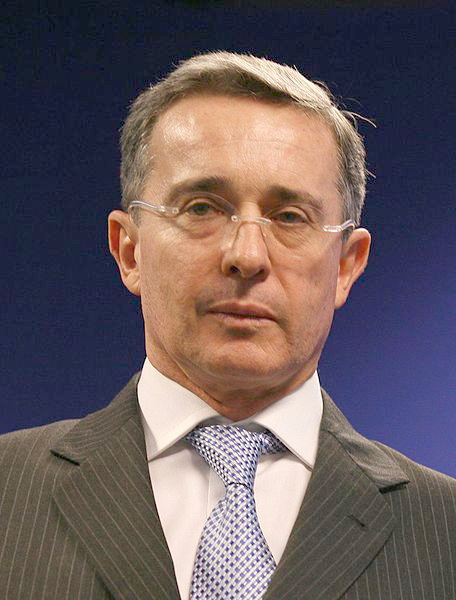
The former president of Colombia, Álvaro Uribe, had two convictions for fraud and bribery overturned on October 21. The rightwing politician, backed by Trump during his first administration, was convicted of bribing imprisoned paramilitaries to discredit claims he was linked to their organizations.
“Colombia’s judicial system found former President Álvaro Uribe Vélez guilty of witness tampering, specifically for abuse of process and bribing a public official,” according to Gimena Sánchez-Garzoli, writing for the Washington Office on Latin America.
Uribe collaborated with paramilitary death squads during Colombia’s war against FARC (Fuerzas Armadas Revolucionarios de Colombia), a revolutionary group formed in 1964 by the Colombian Communist Party to defend what were then autonomous Communist-controlled rural areas. He faced numerous allegations of human rights abuses during his stint in office from 2002 to 2010. Uribe turned a blind eye to extrajudicial killings and massacres by death squads, according to human rights organizations.
During the first Trump administration, then senators Marco Rubio and Bob Menendez (later convicted on corruption charges), both serving as members on the Senate Foreign Relations Committee, shared a “close relationship” with Uribe. Rubio stated that he is “a big fan of President Uribe,” while “multiple sources confirm that Rubio and Uribe are in constant communication, while others confirm that Uribe is a frequent fixture in the U.S. Congress.”
This support was evident last year when Uribe held a conference in Miami. During the event, Rubio, accompanied by Representatives Mario Diaz-Balart and Carlos Curbelo, applauded Uribe as, “a leader who stands up for democracy in Colombia and the threat of a possible leftist tyranny backed by Cuba and Venezuela.”
Rubio believes “the United States should continue to support Colombia’s efforts to combat terrorism and narcotics,” despite an allegation that the former Colombian president was a cartel operative.
Uribe’s Link to Pablo Escobar and the Medellín Cartel
In 1991, a US Defense Intelligence Agency (DIA) report was released under a Freedom of Information Act request filed by the National Security Archives (NSA). The report “placed Uribe, then a senator, among Colombia’s top narcotrafficking figures,” and said he was “dedicated to collaboration with the Medellin Cartel at high government levels” and was “a close personal friend of Pablo Escobar,” according to the NSA.
A diplomatic cable listed Uribe as a Colombian “Narcopols,” and further stated that “an Uribe ally told the Embassy that the notorious Ochoa Vásquez brothers, co-founders of the Medellín Cartel, had ‘financed’ Uribe’s Senate campaign.” Moreover, according to the NSA, documents “reinforce the idea that Uribe’s links to the illegal militias have always been something of an open secret, part of a wider acceptance of paramilitaries among certain Colombian elites.”
“Washington portrays Uribe as a key ally in the war on drugs and terrorism, boasting that his administration has extradited 150 accused traffickers to the US, more than twice the number extradited in his predecessor’s four-year term,” notes the NSA’s David Bloom, citing an article in The New York Times. “But there have been persistent claims that as chief of Colombia’s civil aviation authority in the late 1980s, Uribe protected drug flights. When he was governor of Antioquia between 1995 and 1997, paramilitary activity exploded in the department.”
Targeting Leftist Governments, Not Drugs
Image: President Gustavo Petro Urrego of Colombia addresses the UN General Assembly in 2023 (Photo credit: UN)

The problem for the US with Gustavo Petro is not drugs. It is the fact he is a leftist with an ambitious agenda. In late 2022, with the help of centrist and right-wing parties (the “Historic Pact”), he passed a progressive tax reform. The law increased taxes on Colombia’s top earners and established higher royalties on the extraordinary profits in the extractive industries.
“For the first time in many decades we are talking about taxing the upper echelons of the population in order to finance spending and investments for the poorest people of this country,” Petro said.
In addition, Petro’s government initiated “Total Peace,” a plan to negotiate with all the armed forces operating in Colombia in an effort to end decades-long armed conflict that has killed hundreds of the thousands of Colombians.
César Bowley Castillo, a scholar of Colombian social movements, notes a number of foreign policy achievements attributed to the Petro government.
“Petro’s been a leader on Palestine, and this has created space for other Latin American leaders to take similar stances. Petro has now stopped shipping Colombian coal to Israel. And he’s been a leader on climate. He’s also reestablished relations with Cuba and Venezuela, something no previous president would have done,” Castillo said.
In regard to Venezuela, Petro has worked with Nicolás Maduro on issues of mutual concern, an effort that no doubt alarms the Trump administration. The Colombian president declared “that Colombia and Venezuela are the same people, the same flag, and the same history.” Petro made the remarks “in defense of Venezuela and in response to the threats from the United States,” Natalia Falah wrote for Colombia One in August.
In September, Petro went before the U.N. General Assembly and called for a criminal investigation against President Donald Trump and other officials involved in deadly strikes on fishing boats in the Caribbean that the White House insists were transporting drugs.
“Criminal proceedings must be opened against those officials, who are from the U.S., even if it includes the highest-ranking official who gave the order: President Trump,” Petro said. He said the boat passengers were not members of the Tren de Aragua gang, as claimed by the Trump administration. “They said that the missiles in the Caribbean were used to stop drug trafficking. That is a lie stated here in this very rostrum,” Petro said.
On October 22, Trump expanded his attacks to the Pacific Ocean, where he targeted a vessel off the coast of Colombia, killing two people. It was the ninth attack on vessels the Trump administration insists are operated by “narcoterrorists” attempting to smuggle drugs into the United States.
Manifest Destiny Reprise
The United States has a long history of attacking and undermining governments in Latin America, beginning as early as 1846 with the doctrine of Manifest Destiny and the war against Mexico. In the 1850s, the US intervened in Nicaragua and Panama, the latter at the behest of the Atlantic-Pacific railroad. 1898 brought war with Spain and the US occupation of Cuba, Puerto Rico, Guam, and the Philippines. In the early 20th century, the US passed the Platt Amendment, giving it a freehand to intervene across the Latin America. Cuba, Panama, the Dominican Republic, Colombia, Mexico, Honduras, and Haiti endured US interventions.
“I helped make Mexico, especially Tampico, safe for American oil interests in 1914,” wrote US Marine Major General Smedley Butler. “I helped make Haiti and Cuba a decent place for the National City Bank boys to collect revenues in. I helped in the raping of half a dozen Central American republics for the benefits of Wall Street. The record of racketeering is long. I helped purify Nicaragua for the international banking house of Brown Brothers in 1909-1912. I brought light to the Dominican Republic for American sugar interests in 1916.”
The “record of racketeering” continues today as Donald Trump attempts to force an updated version of the Monroe Doctrine on Latin America. “It has been the formal policy of our country since President Monroe that we reject the interference of foreign nations in this hemisphere and in our own affairs,” Trump declared during a September 2018 speech before the United Nations.
The current “interference” stems from the involvement of China and Russia in Mexico, Columbia, Cuba, Nicaragua, Venezuela, Bolivia, Peru, and Ecuador. In addition to foreign trade, in both consumer goods and military hardware, the US has, since the Cold War, attempted to undermine socialist governments in Latin America. The US claimed to be fighting the spread of communism. Its coups and establishment of authoritarian regimes has resulted in widespread death, suffering, and poverty.
Over the last thirty odd years, the has US shifted the focus in Latin America from defeating communism, and later terrorism, to the war on drugs. It can be argued Trump is less interested in combatting the drug cartels than maintaining the “Washington Consensus” of “trade liberalization” enforced by the International Monetary Fund, the World Bank, and the US Treasury.
“Across Latin America, governments are watching with growing unease as a new kind of Monroe Doctrine seems to be taking shape,” writes Pierre Haski. “Trump seems to draw inspiration from that imperial era.”
Again, the underlying motivation, obfuscated by a claim to be fighting against drugs and narcoterrorists, is to make sure Latin America is dominated by Wall Street interests, and unfriendly leaders such as Maduro and Petro are driven from power and corporations enjoy the freedom to extract oil and critical minerals like lithium and copper without the resistance of nearly 700 million people, more than 170 million of them living in extreme poverty.
*
Click the share button below to email/forward this article. Follow us on Instagram and X and subscribe to our Telegram Channel. Feel free to repost Global Research articles with proper attribution.
Kurt Nimmo is a journalist, author, and geopolitical analyst, New Mexico, United States. He is a Research Associate of the Centre for Research on Globalization (CRG).
Discover more from Don't Speak News
Subscribe to get the latest posts sent to your email.